


Burncrete’s ILULA dual-speed manual chain hoist targets productivity
- Mar 2
- 4 min read
Updated: Apr 15
Lifting and rigging supplier Burncrete has introduced what it describes as an industry-first dual-speed manual chain hoist, a development aimed at improving productivity and reducing operator fatigue in high-capacity lifting applications. Lifting Africa spoke to managing director Zubair Fajandar to find out more.
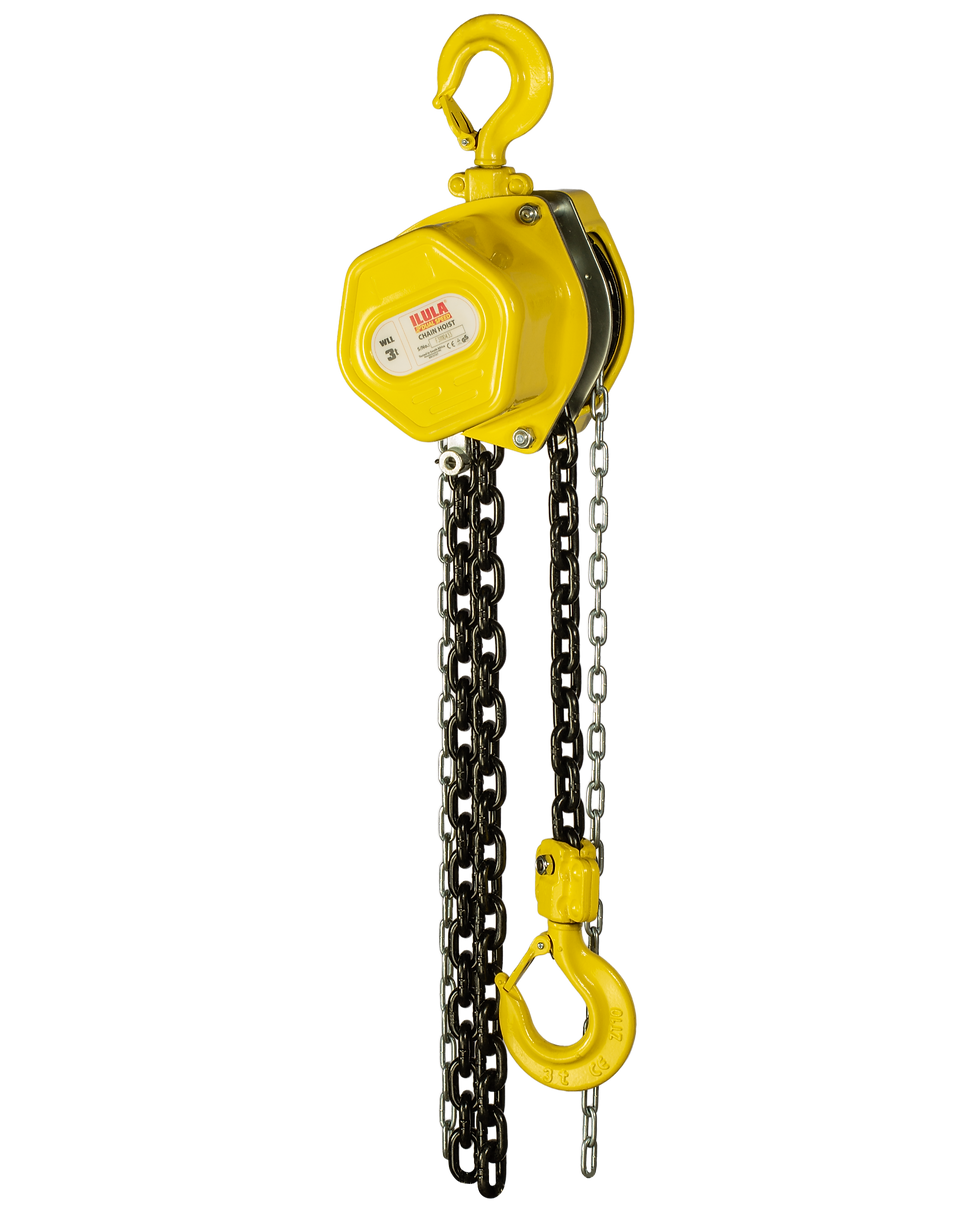
Burncrete has been distributing the ILULA range of chain and lever blocks in Southern Africa for more than two decades, supplying the brand into a wide range of industrial applications.
“We’ve been working with ILULA since 2004 and what has always stood out is the balance between durability, compliance and practicality,” says Fajandar.
“It’s a product range that has proven itself over many years in real operating conditions across sectors such as mining, construction, engineering and marine. It has a solid reputation for strength and reliability.”
For the most part, manual chain hoists have seen little meaningful innovation, particularly in the manual segment, making the introduction of a dual-speed mechanism a notable development for the industry.
According to Fajandar, the new hoist was developed specifically to improve productivity in applications where time constraints, repetitive tasks and operator fatigue are ongoing challenges - an area where manual chain hoists have changed little for many years.
The hoist, which is already available in South Africa, addresses a market where downtime and lead times directly affect project performance.
“This is not a marginal improvement, it’s a fundamental shift in how a manual chain hoist operates,” says Fajandar. “The dual-speed mechanism allows operators to position loads up to five times faster under no load, while automatically reverting to standard speed the moment load is applied, without compromising safety.”
Technically, the hoist operates at high speed when less than 2.2% of the rated capacity is on the hook. As soon as that threshold is exceeded, the mechanism automatically shifts to normal operating speed, ensuring performance remains within design and safety parameters. “On high-capacity, multiple-fall chain hoists, this difference is game-changing,” says Fajandar. “It not only saves time and improves efficiency, but also reduces labour costs and operator fatigue.”
Early market response
While it is still early days, Fajandar says the product has been well received by the market. “We have had a demonstration unit operating at our facilities and the initial feedback has been very positive. This is a completely new concept for our market and most clients have not seen anything like this before.”
He adds that side-by-side comparisons with a standard manual chain hoist have been particularly effective. “By physically comparing the two units and allowing customers to handle the hoist, move the hand chain and experience the difference first-hand, the improvement in operating speed becomes immediately apparent. The response has been one of genuine interest and, in many cases, clear enthusiasm.”
While the dual-speed hoist is priced above a standard manual chain hoist, Fajandar argues that the return on investment is compelling, particularly in labour-intensive applications and higher-capacity units such as five-, ten- and 20-ton hoists.
In these applications, multiple falls of load chain are required to handle heavier loads, meaning operators must move the hand chain significantly more to reposition the hook.
“It’s not about using a bigger chain - it’s about having the chain running through multiple falls,” he says. “That means repositioning the hook under no load can take a lot of time. This is exactly where the dual-speed function delivers its biggest benefit. You’re saving time, reducing operator fatigue and improving daily throughput. In real terms, that can translate into productivity improvements of around 40% in certain applications.”

He notes that reduced fatigue also has safety implications. “Manual lifting is repetitive work. Anything that reduces strain on the operator lowers the risk of injury and error. Safety has always been central to lifting equipment, and this innovation strengthens that position rather than undermining it.” The hoist does weigh slightly more than a conventional unit due to the enlarged gear cover required to accommodate the automatic transmission mechanism. However, Fajandar says this is only relevant during installation and has no impact during operation.
Burncrete, which supplies lifting, rigging, pulling and lashing equipment to the mining, industrial, construction, transport, rail and harbour sectors via resellers and distributors, has built its reputation on stock availability, turnaround times and after-sales support.
“Reliability and spares availability are non-negotiable in lifting,” says Fajandar. “Customers don’t want to replace a hoist simply because parts are unavailable. Total cost of ownership matters, and that includes the ability to repair equipment quickly and safely. High stock availability therefore remains essential — it is about reducing downtime as far as possible and delivering when it matters.”
He adds that while safety standards are well established globally, the market continues to face challenges from non-compliant, low-cost products. “Sub-standard equipment entering the market at very low prices remains one of the biggest challenges for the industry. Some buyers are still purely price-driven, even when compliance and long-term reliability are questionable.”
Burncrete does not deal directly with end users, instead relying on a network of resellers across southern Africa. “Our resellers have the relationships and the boots on the ground,” says Fajandar. “Our role is to supply quality products, maintain stock availability and support them with spares, pricing and technical knowledge so that they can service their customers properly.”
Competitive landscape
Market conditions remain mixed. Fajandar notes that mining activity is performing well, while sectors such as manufacturing and construction have been more subdued.
“It’s a competitive environment. Differentiation is essential, and offering solutions that others don’t have is one way to achieve that.”
Regionally, South Africa remains Burncrete’s largest market, while conditions in neighbouring countries vary. “Mozambique has foreign exchange constraints, Botswana has faced pressure in the diamond sector, and in some markets competitors import directly,” he says. “But regional diversification is important, and when our customers grow, we grow.”
Looking ahead, Fajandar describes Burncrete’s outlook as cautiously optimistic. “We’re investing in digital systems, traceability and service improvements, while continuing to focus on reliability, safety and innovation.”
“We’re not trying to compete in the cheapest segment of the market. Our focus is on better products, better support and long-term value — and that’s where we see sustainable growth.” ILULA dual-speed manual chain hoist
Burncrete,
+27 (0) 11 616 1012,

Comments