


New Holland’s Hybrid Telehandler Prototype
New Holland’s hybrid telehandler prototype pairs battery electric drive with compressed natural gas to deliver a full-day low-emission autonomy – a 70% reduction in CO2 and no compromise on lift performance. We get the engineering story behind this already award-winning design.
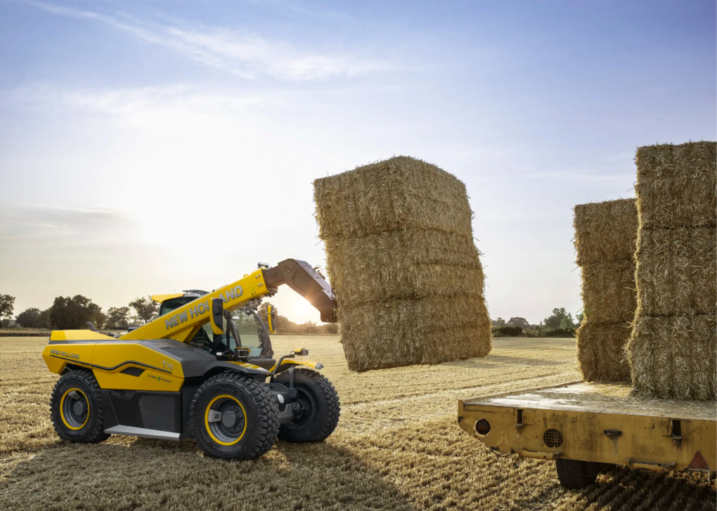
For farming operations looking to cut emissions without sacrificing a minute of working time, the gap between battery-electric machines and conventional diesel has remained stubbornly wide — until now. New Holland’s latest prototype pairs electric drive with compressed natural gas (CNG) in a hybrid telehandler targeting the agricultural market, promising the autonomy of diesel with a fraction of the carbon footprint. Unveiled at Agritechnica 2025, and already the recipient of an iF Design Award 2026, the machine is currently at prototype stage and undergoing field trials with customers.
But its specification sheet reads like a production-ready proposition: maximum lift height and weight figures of 7–9m and 4.2 tonnes, a 70kWh battery, 84kW (112hp) of hydraulic power, 115kW (154hp) for traction and up to 70% lower CO₂ emissions than a diesel equivalent. “The hybrid telehandler is designed to address the gap between battery-electric machines with limited autonomy and conventional diesel models that rely on fossil fuels. This allows customers to transition toward alternative power solutions without changing the way they work,” says Marco Gerbi, global product marketing manager, CNH Industrial.
Bridging the gap
The core challenge for any hybrid machine in agriculture is matching the working day of a diesel machine. Battery-only telehandlers can run for a few hours at best under heavy loads, while diesel units offer all-day endurance but at the cost of emissions, noise and fuel costs. New Holland’s answer is a serial hybrid architecture in which the internal combustion engine does not directly drive the machine.“The internal combustion engine mainly acts as an on-board re-charger, operating continuously in its most efficient zone to minimise fuel consumption, emissions and wear. For the customer, this translates into lower operating costs and more predictable machine behaviour,” says Gerbi.
The 2.8-litre, four-cylinder FPT F28 methane engine generates 75kW (100hp) and runs at a fixed speed — a deliberate engineering decision. Rather than varying engine RPM to meet demand, the powertrain keeps the engine at its peak-efficiency operating point while the battery and electric motors handle the variable loads of traction and hydraulics independently. ABOVE: The distinctive rear lighting signature and Hybrid Power branding on the cab glazing reflect the design language that earned New Holland an iF Design Award 2026. In full-electric mode, the machine can operate for up to four hours on medium-heavy tasks and up to six hours on lighter-duty cycles. When heavier work drains the battery, the methane engine kicks in automatically to provide supplementary power and recharge simultaneously — and the operator does not have to touch a thing.
“The transition between full-electric and hybrid operation is fully seamless for the operator and managed automatically by the machine’s control system,” Gerbi says. “Advanced power management software continuously evaluates operating conditions and energy demand, selecting the most efficient mode without requiring any action from the driver.”
That said, the system does not lock the operator out of decision-making. In enclosed environments such as barns and livestock buildings — where zero emissions and low noise are valuable — the driver can manually inhibit engine start and run the machine on battery power alone.
Engineering complexity
Marrying high-voltage electric components with high-pressure CNG storage in a single compact chassis was far from straightforward. Gerbi identifies two principal hurdles the development team had to clear. “The first was power management. Managing energy flows between the CNG engine, the electric drive and the battery system in a serial hybrid architecture is highly complex, especially for agricultural and telehandler-type machines with variable duty cycles.”
Clear solutions
To solve it, New Holland developed and patented a dedicated power management strategy specifically for telehandler and agricultural applications. The system maximises overall efficiency while maintaining the autonomy needed for a full working day. ABOVE: The rear lighting signature and Hybrid Power branding on the cab glazing reflect the design language that earned New Holland an iF Design Award 2026.
The second major challenge centred on safety commitments and regulatory compliance. “High-voltage electric components and high-pressure CNG systems must operate together in the same machine, which requires extremely robust safety concepts,” Gerbi says. “This involved careful system integration, redundancy strategies and strict adherence to both electrical and gas-related regulations.”
Hydraulics and chassis
One area where continuity mattered most was the hydraulic system. The 84kW (112hp) output at the pump matches the standard machine, and Gerbi is keen to stress that operators will notice no difference in lifting or handling capability. “The pump is no longer driven mechanically by the internal combustion engine, but instead by a dedicated electric motor. The hydraulic pump is positioned very close to the oil tank and in a lower installation area, which reduces hydraulic line length. This layout improves overall efficiency and reliability by minimising pressure losses and potential leak points.”

Accommodating the battery pack, CNG tanks, electric drivetrain and methane engine within a telehandler envelope demanded a full chassis redesign. Gerbi acknowledges this is still a work in progress. “The hybrid architecture is different from a conventional machine, so key structural subsystems were re-engineered to integrate the energy storage systems and electric components. As this is a pre-series configuration, further structural optimisation may still be required ahead of full series production.”Despite those changes, weight distribution has been carefully managed. Key performance benchmarks including maximum lift height and load capacity remain fully aligned with the conventional model, with no compromise on stability at full reach.
Inside the cab
The operator interface has been updated to reflect the dual-energy powertrain. A dedicated workingmode selector allows the driver to activate full-electric operation, while the main display now integrates realtime data on battery state of charge, methane fuel level and overall energy flow. “This keeps operation simple and intuitive, even with advanced technology on board,” says Gerbi.
Fast and flexible charging
Charging infrastructure is another practical consideration. The system supports DC fast charging up to 150kW for rapid turnarounds, but is also compatible with more common EV charging solutions, allowing flexible recharging depending on what a farm already has in place. For operations with solar panels, the electricity generated on-site can be used to recharge the batteries – creating a closed-loop energy cycle.
Fuel-Flex thinking
The choice of CNG as the range-extender fuel was not arbitrary. Gerbi reveals that the telehandler sits on what New Holland calls a Fuel-Flex platform — an architecture designed to accept different engine technologies depending on market needs, with the electric driveline as the constant. “Development started with CNG due to its low environmental impact and more demanding packaging requirements, making future adaptation to other fuels easier,” he says. “This makes the platform a future-proof investment for different markets and energy scenarios.”
ABOVE: The prototype retains the conventional model’s 7–9m lift height and 4.2-tonne capacity, while the reconfigured chassis integrates the battery pack, CNG tanks, electric drivetrain and methane engine. It is a telling detail. By tackling the hardest integration challenge first — fitting high-pressure gas tanks alongside high-voltage batteries — New Holland has effectively opened the door to simpler drop-in alternative fuel solutions down the line, such as hydrogen. A fully battery-electric version, however, is not being considered. Gerbi is direct on the point. The hybrid configuration delivers equivalent power, autonomy and performance to a diesel counterpart while eliminating the run-time limitations of battery-only machines. In real agricultural duty cycles, the hybrid telehandler can operate for a full working day without refuelling or recharging.
Validation and testing
New Holland is drawing on both its agricultural heritage and its construction division’s experience with hybrid and electric machines to validate the prototype. “The hybrid powertrain is validated using New Holland’s standard durability and reliability protocols, based on duty cycles that have been measured and confirmed through thorough and extensive real-world field experience,” says Gerbi. “These validation protocols also leverage New Holland’s Construction expertise, built on the development and production of hybrid and electric machines within the construction equipment domain.”
On top of that, the hybrid architecture undergoes specific validation programmes for the high-voltage electrical system and the methane fuel system, each with its own safety and regulatory requirements. The machine has already demonstrated its environmental credentials in field tests, with CO¬ emissions reduced by up to 70% compared to diesel-powered telehandlers — particularly where methane from energy-independent farms or renewable electricity is used. Productivity gains of up to 30% over a comparable diesel machine have also been recorded. This is thanks to faster response, smoother control and optimised power distribution.
What comes next
As for the path to production, Gerbi keeps expectations measured. “Even though the machine is currently at prototype stage, development is progressing steadily. More precise timing and next steps will be communicated in the near future. The initial rollout is expected to focus on core European agricultural markets, where regulatory frameworks, infrastructure readiness, and customer demand for alternative power solutions are most advanced.”
For now, the hybrid telehandler remains a prototype, but one that has already won an internationally recognised design award and logged real performance data. If New Holland is able to translate those numbers into a production-ready machine, it may well have built the bridge that midsize farms need to cross into a lower-carbon future.
New Holland,


Comments