


Man cages all you need to know
- May 7
- 4 min read
We have all heard many different stories about man cages, let us try to validate them. The law on this equipment type is quite direct and simple.

The man/woman cages must be manufactured in accordance with the standard, and the standard is SANS 583 for a “Non-integrated work platforms for occasional use on lift trucks” cage; the below-a-hook type must conform to SANS 54502 – Suspended Cage. The Driven Machinery Act only states that you cannot lift a person using a lifting machine unless the person is in a man-cage that meets SANS standards and has been signed off by an Inspector (DoEL) for use on site. It does not dictate the spec or shape. See Below. (8) No user shall require or permit any person to be moved or supported by means of a lifting machine unless that machine is fitted with a man-cage designed and manufactured according to an approved SANS standard approved for that purpose by an inspector, and after a risk assessment has been done.
If you now consult the mentioned standards, you will find much more information on who should design, inspect, and test, how strong they should be, and much more technical information.
The standards also do NOT mention what DoEL want to see when they get there to approve the cages.
Over the years, there have been many different documents, some from DoEL in various provinces and many others NOT even from DoEL, circulating in the industry about what is needed and required before it can be signed off.
Cages used in the Mining Industry could have additional requirements and are declared suitable for use by the Mine Engineer. The DoEL rules will suffice for these cages.

Let me list a few myths that you should not believe:
1. There are some manufacturers that make a “DoEL-Approved” cage.
NO! The manufacturer can, or rather, should supply an “approvable” cage, but the end user must have this approval done at the site of use. The cage cannot be supplied with a new cage approved by DoEL for this design. This is a good selling scam!
2. The DoEL don’t come to the site anymore; they approve them over the phone.
NO! They can be called to be invited; sometimes, several calls will be made. They will come to the site to do this. No alternative.
3. Only PR Eng approvals will be allowed or considered by DoEL.
PR Tech is stated in the SANS standards. PR Eng will be an added benefit, but not the minimum requirement.
4. Cheaper imported, thin tube, large square blocked fenced cages will be approved by DoEL.
The dipped galvanised, thin type with the large holes in the backrest mesh may not pass the approval process. The simplest reason for non-approval is that the holes in the backrest mesh are larger than permitted by SANS 583. Check size, if correct, you stand a chance but see the QA Data-pack you will need for DoEL. Make sure you get that.
5. That specific dimension and thickness of steel is used to make the cage.
NO! Any steel thickness, or as specified by the PR Tech, that meets the standard’s strength requirements can be used.
6. That the cage must be cladded with expanded metal all over to be approved.
NO! The cage can be open on the sides; the back must be cladded to prevent someone’s fingers from getting stuck in the masts. Not sure who will try that, but it’s needed.
7. It is not allowed to have a combined cage that can be used for suspended lifting and forklift use.
If the cage is made to meet both standards and can have the backrest removed, the combined-cage alternatives are allowed and have been around for a long time.
Be aware that the MHSA (Mine Health & Safety Act) 26 of 1996 may require additional specialised equipment to be fitted. This topic also does not include shaft and conveyance cages.
The last thing is that when DoEL comes to your site, they will check the machine or machines that will be used to make sure it is safe to lift the cage with. They want a certified driver, a tested machine, and a safe operating area in terms of floor levelness, etc… The following list (QA Data Pack) of items will be required when the DoEL come to see the cages on your site.
There may be more in some cases, but this is the minimum requirement.
i. The actual cage to be used and approved by them.
ii. PR Tech or higher, approved drawing and letter approving, but drawing must be there.
iii. Load test certificate. Mostly LMI but do remember the cage is not a machine.
iv. Welding procedure used.
v. Coded welder certificate.
vi. MPI or other NDE certificate of the welds.
vii. Operating procedure, SOP / COP of the device being used.
viii. Risk assessment of the device being used.
ix. Certified operator and tested machine.
The fixed cages that fit on telehandlers, the back of trucks, and MEWPs do not require this approval from DoEL. The machine must be tested and certified. Not sure how this makes sense, but a DoEL rule.
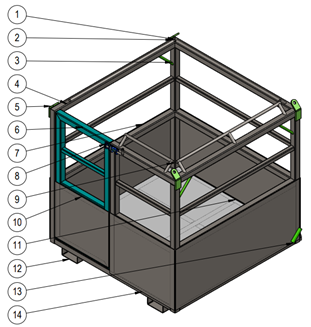
Additions to our norm followed after the publication of the SANS standards quoted had very few changes, but things like;
• the handrail is not the outer frame; there must be a separate (inward-positioned) handrail,
• strength of the roof, if fitted,
• door auto closing and locking device must be an auto lock,
• height and standing space inside the cage,
• drawing can be done by PR Tech, which were added to the old requirements.
Many, many cages used in industry (approximately 80%) are not DoEL approved. That does not make it correct to fall into that user category. The day the accident happens, you will be sorry you never did it because you battled to get DoEL out to the site.
Good luck, have fun, don’t give up.
LEEASA,
+27 (0) 82 859 7384,


Comments